When assembling industrial pipeline systems, the compatibility between stainless steel flanges and valves is the cornerstone of safe operation. A single mismatch in standards, materials, or certification can lead to leaks, unplanned downtime, or even regulatory penalties—costing oil and gas, chemical, or food processing companies an average of $12,000 per hour in production losses. This guide demystifies the critical factors of flange-valve compatibility, backed by international standards and real-world case studies, to help you avoid costly errors.
First Rule: Never Mix ANSI and DIN Standards—Here’s Why
The two dominant flange standards—ANSI (North America) and DIN (Europe/Asia)—are fundamentally incompatible due to differing measurement systems and bolt patterns. Our engineering team recently resolved a crisis for a chemical plant in Germany where a supplier installed ANSI Class 150 flanges with DIN PN16 butterfly valves, resulting in 12 bolt hole misalignments and a 48-hour shutdown to replace components.
| Key Specification | ANSI/ASME B16.5 Standard | DIN EN 1092-1 Standard |
|---|---|---|
| Measurement System | Inch-based (NPS) | Metric (DN) |
| Pressure Rating Notation | Class 150/300/600 (psi) | PN10/PN16/PN25 (bar) |
| Bolt Circle Diameter (DN50/NPS2) | 120.7 mm | 125 mm |
| Bolt Hole Size | 19 mm (4 bolts) | 18 mm (4 bolts) |
Critical Tip: For cross-regional projects, use adapter flanges certified to both standards. Never force-mate mismatched components—this warps flange sealing faces and invalidates warranty coverage.
Material Compatibility: 304 vs. 316 Stainless Steel Mixing Risks
While 304 and 316 stainless steels are both austenitic, mixing them in flange-valve assemblies can trigger premature corrosion—especially in harsh environments. A nuclear power plant audit found 304 flanges paired with 316 valves in safety injection systems exceeded temperature-pressure limits per ANSI B16.5-1968, requiring a $2.3 million replacement program.
When Can You Mix Them? (Rare Exceptions)
- Low-corrosion environments: Indoor freshwater systems (chloride <50ppm) with 304 flanges and 316 valves—monitor for crevice corrosion quarterly.
- Low-pressure applications: PN10/Class 150 systems with non-critical media (e.g., compressed air) where 304’s cost advantage outweighs long-term risks.
When to Avoid Mixing (Non-Negotiable)
- Marine/coastal areas: 304 flanges corrode 3-5x faster than 316 in seawater (chloride >19,000ppm)—use full 316L assemblies.
- Chemical processing: Acidic or chloride-based media (e.g., sulfuric acid) cause pitting in 304 within 6-12 months.
- High-pressure systems: Class 300/PN25+ applications where 304’s lower temperature-pressure rating creates safety hazards.
Certification Compliance: Don’t Let PED/CE Fail Your Shipment
For EU and global markets, flange-valve assemblies must meet CE-PED 2014/68/EU requirements if operating pressure exceeds 0.5 bar. A U.S. valve supplier recently had a $500,000 shipment rejected by a French refinery because their 316L flanged ball valves lacked PED Category III certification (required for hazardous media).
Key Certification Guidelines by Market
- EU Market: Classify assemblies by risk (I-IV) — Category IV (e.g., oil/gas valves) requires full H1-mode certification with notified body oversight.
- North America: API 6D certification for oil/gas flange-valve systems; ASME B16.5 for dimensional compliance.
- Russia/CIS: EAC certification per TR CU 010/2011 for mechanical safety, including flange bolt torque and sealing performance.
- Food/Pharmaceutical: FDA compliance for 304/316L surfaces; ensure Ra ≤0.8μm polish on flange sealing faces.
Real-World Case Study: How a Refinery Fixed Compatibility Issues
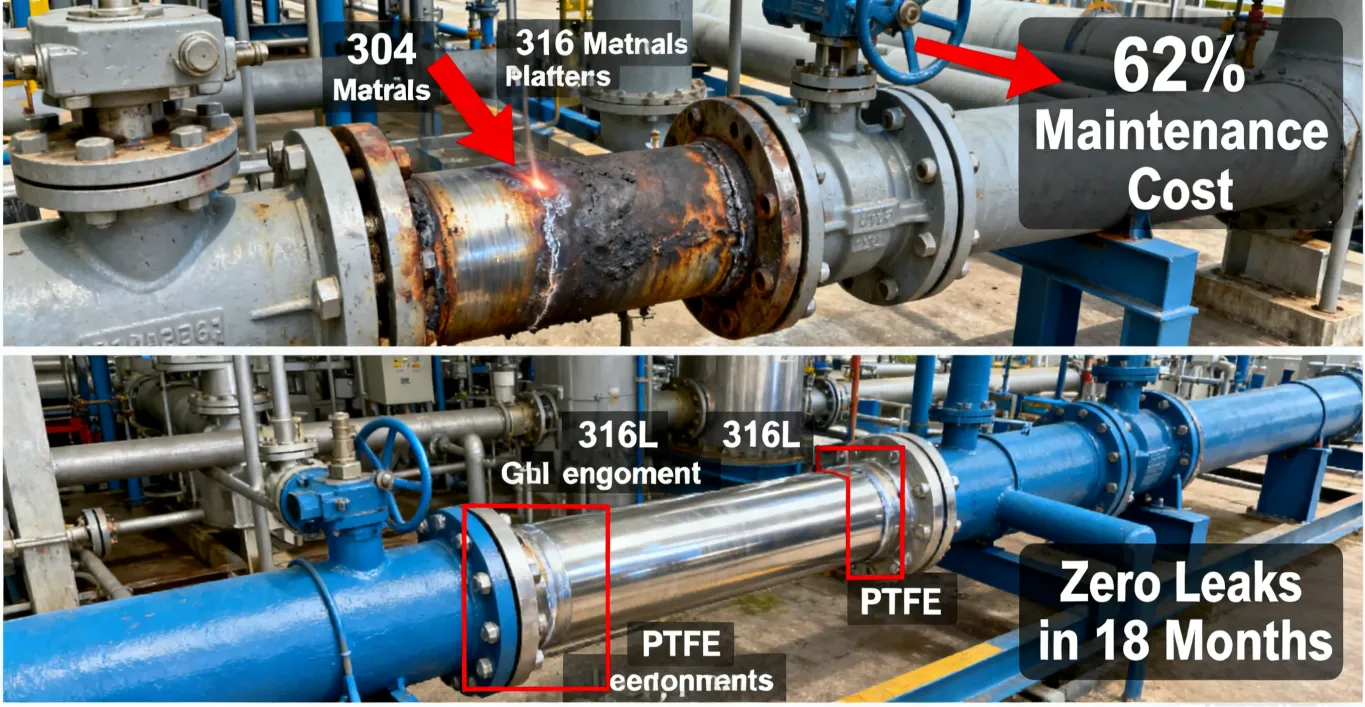
A Middle Eastern offshore refinery faced recurring leaks in their seawater cooling system (316 valves with 304 flanges). Our team implemented three critical fixes:
- Standard Unification: Replaced DIN PN16 flanges with ANSI Class 150 316L flanges to match existing valves (per API 594 face-to-face dimensions).
- Material Alignment: Upgraded all gaskets to PTFE-lined graphite (resists seawater corrosion vs. standard rubber).
- Certification Validation: Obtained PED Category III certification for the full assembly, ensuring compliance with UAE regulatory requirements.
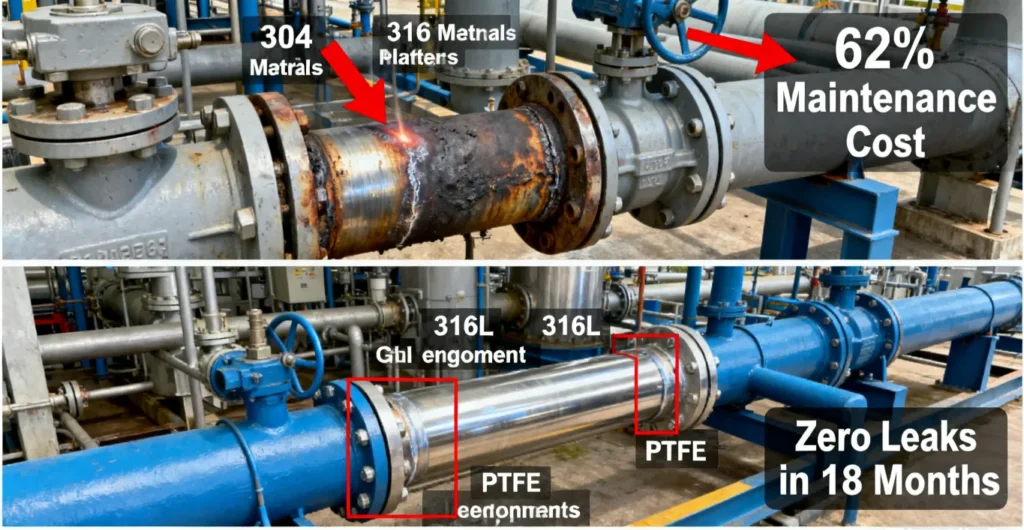
Result: Zero leaks in 18 months; maintenance costs reduced by 62%.
Flange-Valve Compatibility Checklist (Downloadable)
- Standard Verification: Match ANSI/DIN/JIS standards across flanges, valves, and gaskets—use calipers to check bolt circle diameter.
- Material Match: Avoid 304/316 mixing in chloride >50ppm or pressure >10MPa; request MTRs to confirm molybdenum content (316 ≥2%).
- Pressure Rating: Ensure flange rating ≥ valve rating (e.g., Class 300 valve needs Class 300+ flange).
- Certification Check: Validate PED/API/FDA credentials for target markets—never accept “self-declared” certifications for hazardous media.
- Installation Audit: Use cross-torque sequence for bolts (per ANSI B16.21) and inspect sealing face flatness post-installation.
Flange-valve compatibility isn’t just about part numbers—it’s about aligning standards, materials, and certifications with your specific operating environment. Our team provides free compatibility assessments for industrial projects, including 304/316L flange-valve assemblies certified to ANSI, DIN, and API standards. Contact us today to receive your customized compatibility report and avoid costly downtime.




The $12,000 per hour figure for production losses due to mismatched flanges and valves really highlights the financial impact of compatibility issues. It’s interesting that your team found that using adapter flanges could solve these problems, but how often do you see companies still trying to force-mate components despite knowing the risks? It’s crucial to emphasize the importance of proper standards in training and onboarding new engineers.