In industrial piping systems, rubber expansion bellows (also known as rubber expansion joints or rubber compensators) play a critical role in maintaining system integrity, reducing vibration, and accommodating thermal movement. As a professional industrial valve and flange manufacturer with over 20 years of experience, Oucang Valve understands the importance of proper expansion joint selection.
In this comprehensive guide, we’ll explore everything you need to know about rubber expansion bellows, from their design and materials to applications and selection criteria.
What is a Rubber Expansion Bellow?
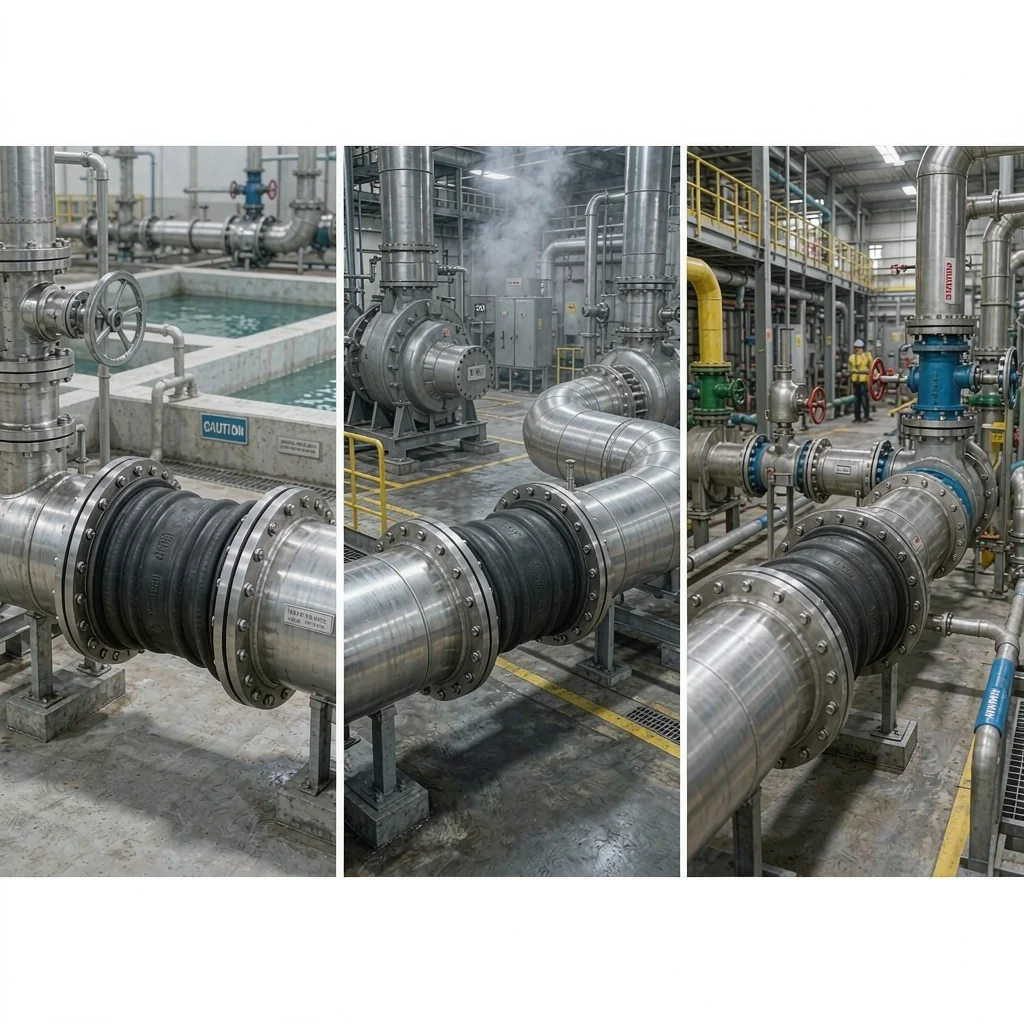
A rubber expansion bellow is a flexible coupling device made from elastomeric materials that connects two sections of piping. It absorbs movement caused by thermal expansion, vibration, and misalignment while maintaining a pressure-tight seal.
Key Functions:
- Absorb thermal expansion: Compensate for pipe length changes due to temperature variations
- Dampen vibration: Reduce noise and vibration from pumps and equipment
- Accommodate misalignment: Compensate for slight pipe misalignment during installation
- Isolate stress: Prevent stress transfer between connected equipment
- Reduce noise: Minimize water hammer and flow-induced noise
Main Components:
| Component | Material | Function |
| Inner Liner | Natural rubber, EPDM, NBR, Viton | Contains media, provides sealing |
| Reinforcement Layer | High tensile fabric, steel wire | Provides strength and pressure rating |
| Outer Cover | Natural rubber, EPDM, chloroprene | Protects against environmental damage |
| Flange Connections | Carbon steel, stainless steel | Connects to piping system |
Types of Rubber Expansion Bellows
Understanding the different types helps you select the right expansion joint for your application.
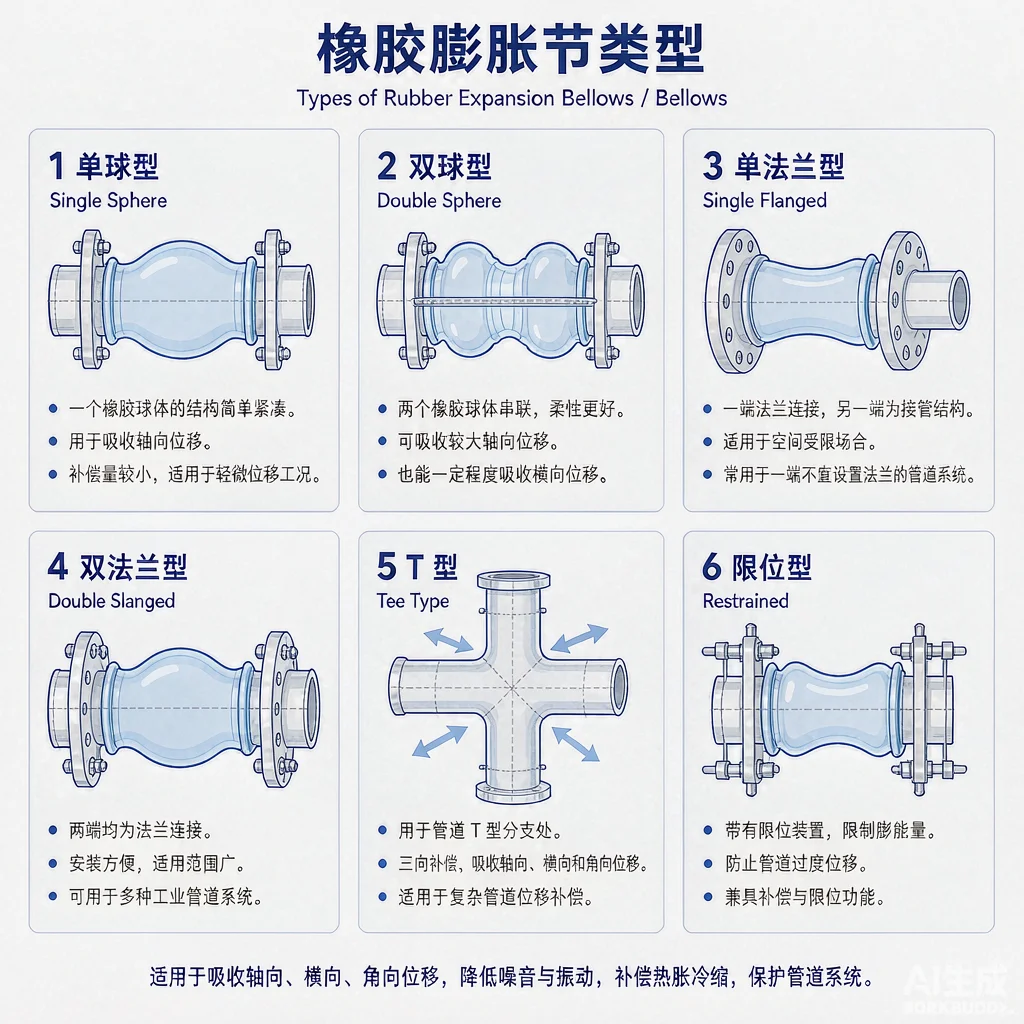
1. Single Sphere Expansion Joint
Characteristics:
- Single bellows section
- Limited movement capability
- Compact design
- Cost-effective solution
Best for:
- Low-pressure systems
- Small diameter pipes (under 12″)
- Light vibration applications
- Budget-conscious projects
Movement Capability:
- Axial: ±25mm
- Lateral: ±15mm
- Angular: ±3°
2. Double Sphere Expansion Joint
Characteristics:
- Two bellows sections connected in series
- Higher movement capability
- Better vibration absorption
- More flexible installation
Best for:
- Medium-pressure systems
- Larger diameter pipes
- High vibration applications
- Pump discharge lines
Movement Capability:
- Axial: ±50mm
- Lateral: ±30mm
- Angular: ±6°
3. Single Flanged Expansion Joint
Characteristics:
- One flanged end, one plain end
- Easy installation
- Cost-effective
- Limited to one-side connection
Best for:
- Connecting to equipment with threaded ends
- Temporary installations
- Maintenance-friendly systems
4. Double Flanged Expansion Joint
Characteristics:
- Flanges on both ends
- Standard installation
- Maximum flexibility
- Most common type
Best for:
- Standard piping connections
- High-pressure applications
- Critical service requirements
- Industrial plants
5. Tee Type Expansion Joint
Characteristics:
- Three-way configuration
- Complex movement absorption
- Specialized applications
- Higher cost
Best for:
- Branch line connections
- Complex piping networks
- Specialized industrial processes
6. Restrained Expansion Joint
Characteristics:
- Built-in restraint mechanism
- Prevents separation under pressure
- Handles high pressure and thrust
- Safe for critical applications
Best for:
- High-pressure systems
- Critical service applications
- Areas with high thrust forces
- Safety-critical installations
EOF—
Rubber Materials and Their Applications
Selecting the right rubber material is crucial for ensuring expansion joint longevity and performance. Different materials offer varying resistance to temperature, chemicals, and environmental conditions.
1. Natural Rubber (NR)
Properties:
- Temperature range: -30°C to +70°C (-22°F to 158°F)
- Excellent elasticity and flexibility
- Good abrasion resistance
- Affordable price
Best for:
- Water systems
- Air and gas services
- General industrial applications
- Non-oily environments
Advantages: ✓ High elasticity ✓ Good fatigue resistance ✓ Cost-effective ✓ Easy installation
Limitations: ✗ Poor oil resistance ✗ Limited temperature range ✗ Not suitable for ozone exposure
2. EPDM Rubber (Ethylene Propylene Diene Monomer)
Properties:
- Temperature range: -50°C to +150°C (-58°F to 302°F)
- Excellent weather and ozone resistance
- Good steam and hot water resistance
- Chemical resistant to alkalis and acids
Best for:
- Hot water systems
- Steam applications
- Chemical processing
- Outdoor installations
- HVAC systems
Advantages: ✓ Wide temperature range ✓ Excellent weather resistance ✓ Good chemical resistance ✓ Long service life
Limitations: ✗ Poor oil and fuel resistance ✗ Higher cost than natural rubber ✗ Not suitable for hydrocarbons
3. Nitrile Rubber (NBR)
Properties:
- Temperature range: -30°C to +100°C (-22°F to 212°F)
- Excellent oil and fuel resistance
- Good abrasion resistance
- High tensile strength
Best for:
- Oil and fuel lines
- Petrochemical applications
- Hydraulic systems
- Fuel transfer pipelines
Advantages: ✓ Excellent oil resistance ✓ Good mechanical properties ✓ Affordable price ✓ Wide availability
Limitations: ✗ Poor ozone resistance ✗ Limited temperature range ✗ Not suitable for hot water
4. Viton (FKM) Rubber
Properties:
- Temperature range: -20°C to +200°C (-4°F to 392°F)
- Superior chemical resistance
- Excellent high-temperature performance
- Outstanding weather resistance
Best for:
- Aggressive chemical services
- High-temperature applications
- Pharmaceutical industry
- Semiconductor manufacturing
Advantages: ✓ Exceptional chemical resistance ✓ High-temperature capability ✓ Long service life ✓ Compatible with most media
Limitations: ✗ Very expensive ✗ Limited flexibility ✗ Special ordering required
5. Butyl Rubber (IIR)
Properties:
- Temperature range: -40°C to +120°C (-40°F to 248°F)
- Excellent gas barrier properties
- Good chemical resistance
- Low compression set
Best for:
- Gas pipeline applications
- Pharmaceutical processes
- Food and beverage industry
- Sanitary applications
Advantages: ✓ Excellent gas tightness ✓ Good chemical resistance ✓ Low compression set ✓ Hygienic surface
Limitations: ✗ Poor oil resistance ✗ Lower elasticity ✗ Higher cost
Technical Specifications
Pressure Ratings
Rubber expansion bellows are available in various pressure classes:
| Pressure Class | Maximum Pressure | Typical Applications |
| PN10 | 10 bar (145 psi) | Low-pressure water systems |
| PN16 | 16 bar (232 psi) | General industrial service |
| PN25 | 25 bar (363 psi) | Medium-pressure systems |
| PN40 | 40 bar (580 psi) | High-pressure applications |
| Class 150 | 285 psi (19.6 bar) | ANSI standard systems |
| Class 300 | 740 psi (51.0 bar) | High-pressure industrial |
Note: Actual pressure rating depends on diameter, material, and construction.
Size Range
Standard Sizes:
- Small diameter: DN50 to DN200 (2″ to 8″)
- Medium diameter: DN200 to DN600 (8″ to 24″)
- Large diameter: DN600 to DN2000 (24″ to 80″)
Custom Sizes:
- Available upon request
- Special configurations possible
- Lead time: 2-4 weeks
Industry Applications
Rubber expansion bellows are used across numerous industries due to their versatility and reliability.
Water and Wastewater Treatment
Applications:
- Intake and outfall piping
- Pump station connections
- Filter system isolation
- Pipeline distribution
- Wastewater treatment plants
Why use rubber expansion joints:
- Corrosion resistance
- Vibration isolation from pumps
- Thermal movement compensation
- Easy maintenance access
Power Generation
Applications:
- Cooling water systems
- Feedwater piping
- Condenser connections
- Steam lines (with EPDM)
- Heat exchanger connections
Benefits:
- Handles thermal cycling
- Reduces pipe stress
- Absorbs pump vibration
- Prevents equipment damage
Oil and Gas
Applications:
- Pipeline connections
- Refinery piping
- Offshore platforms
- Storage tank systems
- Loading/unloading arms
Special requirements:
- Oil-resistant materials (NBR, Viton)
- High-pressure ratings
- Fire-resistant options
- Corrosion protection
Chemical Processing
Applications:
- Reactor connections
- Process piping
- Acid and alkali lines
- Solvent transfer
- Chemical storage systems
Material selection:
- EPDM for general chemicals
- Viton for aggressive media
- PTFE-lined for high purity
- Custom solutions available
HVAC and Building Services
Applications:
- Chilled water systems
- Heating water loops
- Air handling units
- Pump connections
- Fan coil units
Advantages:
- Noise reduction
- Vibration isolation
- Thermal movement compensation
- Cost-effective solution
Marine and Shipbuilding
Applications:
- Ballast water systems
- Cooling water lines
- Fire protection systems
- Fuel oil lines
- Bilge pumping
Special features:
- Saltwater resistance
- Marine-grade materials
- Custom flange patterns
- Corrosion protection
Installation Guidelines
Proper installation is essential for maximizing expansion joint life and performance.
Pre-Installation Checks
Before installation, verify:
- Correct size and pressure rating
- Proper material selection for media
- Flange compatibility with piping
- No damage during shipping
- Clean pipe ends and flange faces
- Correct gasket type and condition
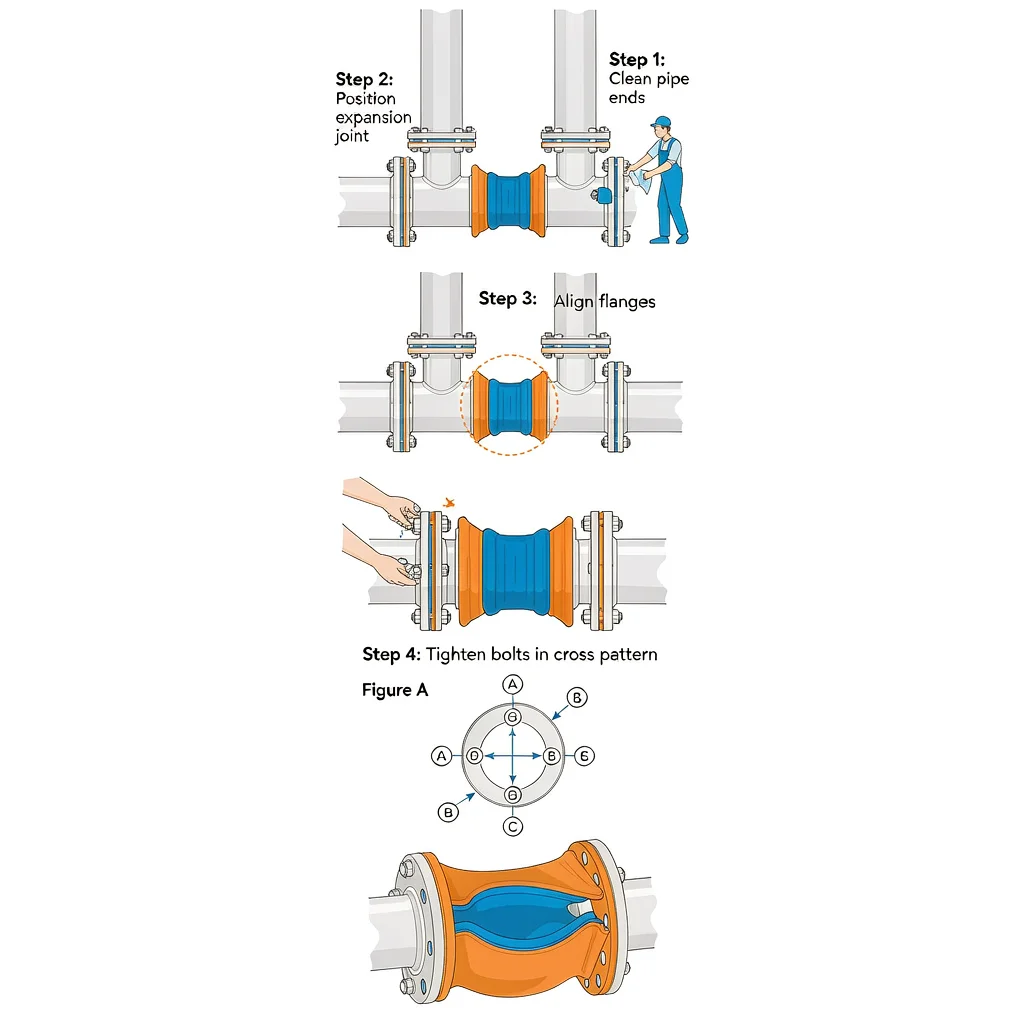
Installation Steps
Step 1: Preparation
Step 2: Positioning
Step 3: Bolt Tightening
Step 4: Final Inspection
Common Installation Mistakes
| Mistake | Consequence | Prevention |
| Over-tightening bolts | Crushes rubber, causes leaks | Use proper torque |
| Misalignment | Premature failure | Align pipes correctly |
| Twisting joint | Damages reinforcement | Keep joint straight |
| Missing gaskets | Leaks at flange | Install proper gaskets |
| No movement allowance | Restricts function | Allow proper clearance |
Selection Guide
Choosing the right rubber expansion bellow requires considering multiple factors.
Selection Checklist
1. Media Compatibility
- Identify fluid being handled
- Check chemical compatibility charts
- Consider temperature range
- Evaluate pH level
2. Pressure Requirements
- Determine operating pressure
- Consider pressure spikes
- Select appropriate pressure class
- Check manufacturer’s rating tables
3. Movement Requirements
- Calculate thermal expansion
- Determine vibration amplitude
- Assess misalignment tolerance
- Consider anchor points
4. Environmental Conditions
- Indoor or outdoor installation
- UV exposure
- Temperature extremes
- Chemical atmosphere
5. Regulatory Requirements
- Industry standards (API, ISO, EN)
- Safety certifications
- Material certifications
- Testing requirements
Frequently Asked Questions (FAQ)
Q1: What is the difference between a rubber expansion joint and a metal expansion joint?
Rubber expansion joints are made from elastomeric materials and are best suited for low to medium pressure applications with moderate temperature ranges. They excel at vibration isolation and noise reduction.
Metal expansion joints are made from stainless steel or other metals and can handle higher pressures, temperatures, and more aggressive chemical environments. However, they are more expensive and don’t provide the same level of vibration dampening.
Q2: How long do rubber expansion bellows last?
The lifespan depends on several factors:
- Operating conditions: Temperature, pressure, and media type
- Material selection: EPDM and Viton typically last longer than natural rubber
- Installation quality: Proper installation extends service life
- Maintenance: Regular inspections prevent premature failure
Typical lifespan: 5-15 years under normal operating conditions.
Q3: Can rubber expansion joints be used for steam applications?
Yes, but you must select the appropriate material. EPDM rubber is recommended for steam applications up to 150°C (302°F). For higher temperature steam, consider Viton (FKM) or metal expansion joints.
Q4: How do I identify the correct size for my application?
- Measure the pipe diameter (inside or outside, depending on your flange standard)
- Determine the required movement compensation
- Check the pressure rating requirements
- Consult the manufacturer’s selection guide or contact technical support
Q5: What are the signs that an expansion joint needs replacement?
Warning signs include:
- Visible cracks or deterioration on the rubber surface
- Hardening or loss of elasticity
- Leakage at the flange connection
- Excessive vibration or noise
- Permanent deformation or flattening
- Age exceeding recommended service life
Q6: Do you offer custom rubber expansion joints?
Yes! At Oucang Valve, we offer custom manufacturing services for:
- Non-standard sizes and pressure ratings
- Special material requirements
- Unique flange configurations
- Custom branding and packaging
Contact our sales team for a quote.
Why Choose Oucang Valve?
As a professional manufacturer with over 20 years of experience, Oucang Valve offers:
✓ Quality Assurance: ISO 9001 certified manufacturing ✓ Custom Solutions: Tailored to your specific requirements ✓ Competitive Pricing: Direct factory pricing ✓ Fast Delivery: Standard items in stock ✓ Technical Support: Expert guidance throughout selection ✓ Global Shipping: Worldwide delivery available
Conclusion
Rubber expansion bellows are essential components in industrial piping systems, providing critical functions such as vibration isolation, thermal movement compensation, and noise reduction. Understanding the different types, materials, and selection criteria ensures optimal performance and longevity.
Whether you need a simple single sphere joint for a water system or a complex restrained expansion joint for a high-pressure application, proper selection and installation are key to success.
Get Your Free Quote Today
Need help selecting the right rubber expansion joint for your project? Our technical team is ready to assist you.
Contact Oucang Valve:
- 📧 Email: manager-minly@oucangflange.com
- 🌐 Website: https://oucangflange.com
- 📱 WhatsApp: +86 15067828716
Request a free quote today!