
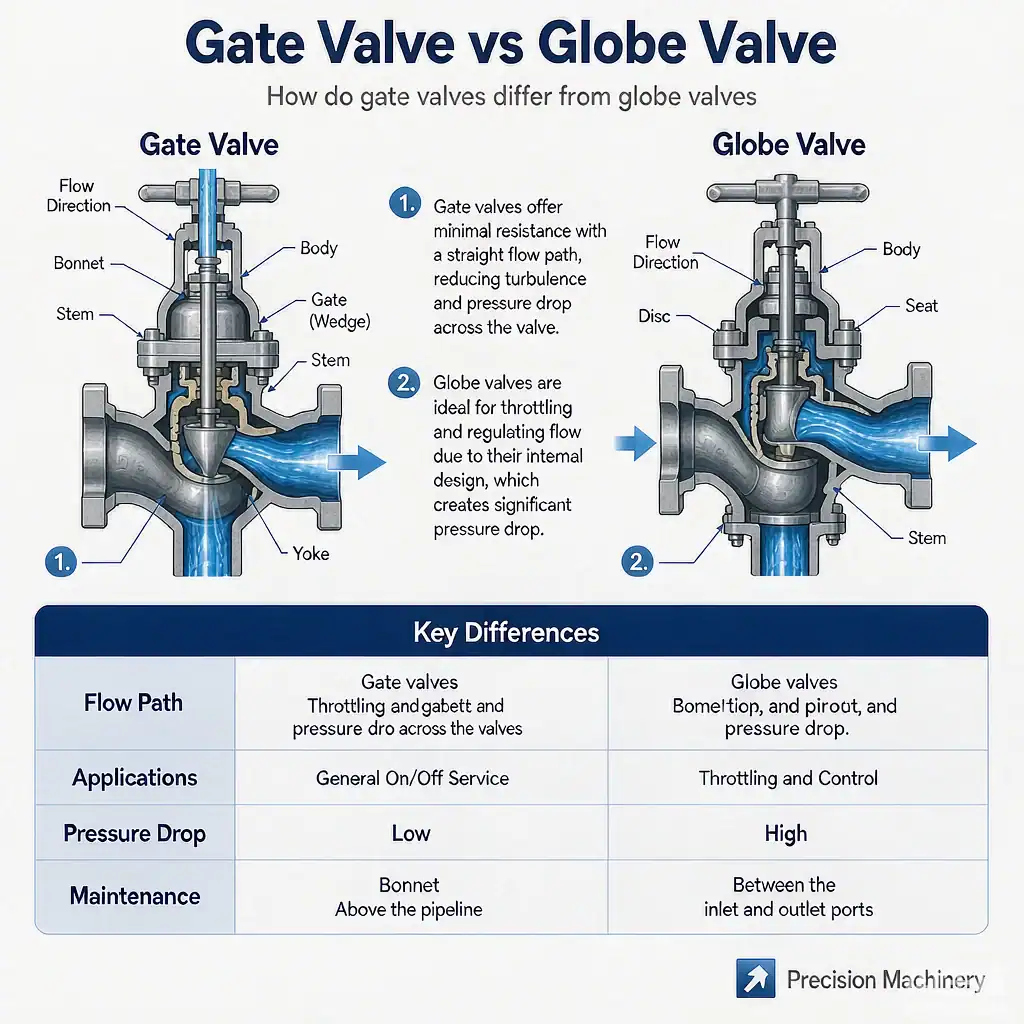
When designing or maintaining industrial piping systems, selecting the right valve type is crucial for optimal performance, efficiency, and cost-effectiveness. Two of the most commonly used manual valves are gate valves and globe valves. While they may look similar at first glance, they serve fundamentally different purposes and excel in distinct applications.
In this comprehensive guide, we’ll explore the key differences between gate valves and globe valves, helping you make an informed decision for your specific piping requirements.
What is a Gate Valve?
A gate valve is a quarter-turn or multi-turn valve that uses a gate or wedge to control flow. When the gate is lifted completely out of the flow path, the valve is fully open, allowing unrestricted flow. When the gate is lowered into the flow path, it blocks the flow completely.
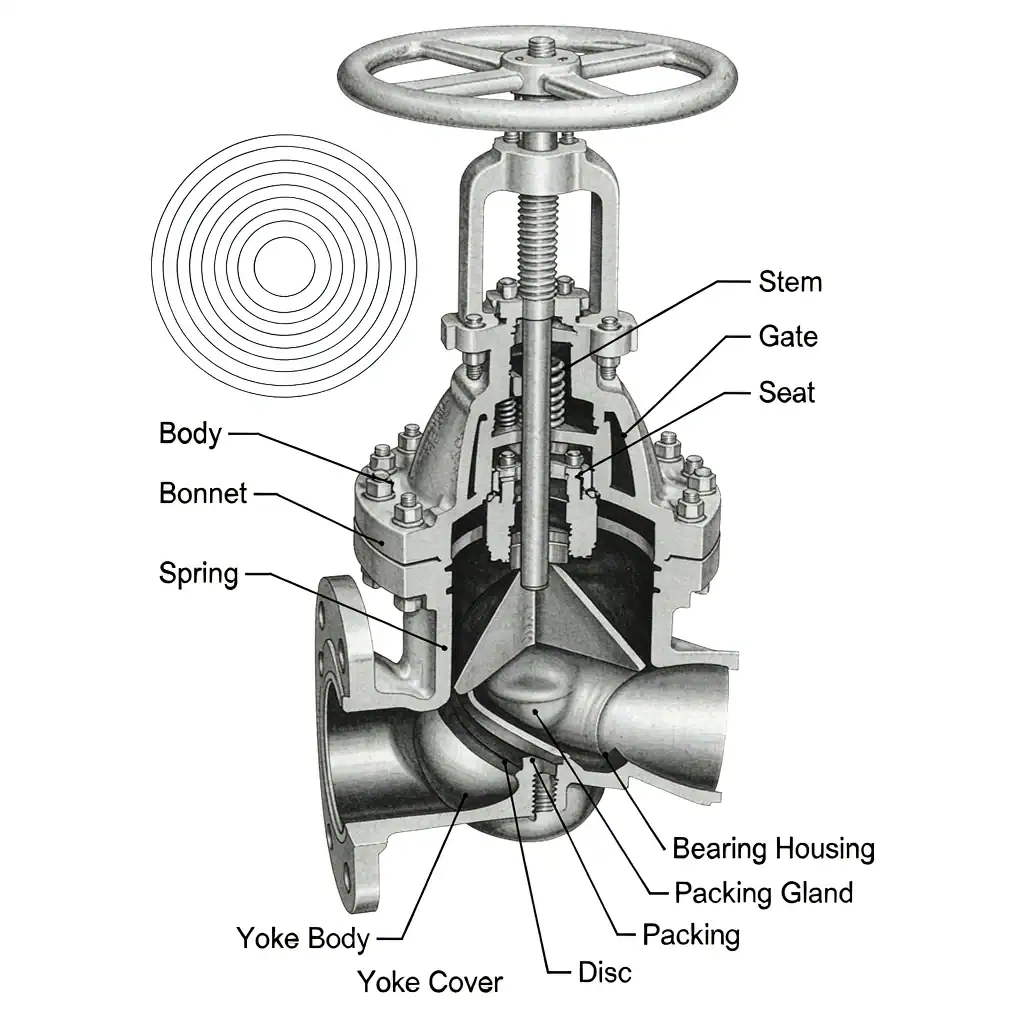
Key Features of Gate Valves:
- Linear motion operation: Stem moves up and down to raise or lower the gate
- Full bore design: Allows unrestricted flow when fully open
- On/off service: Best suited for isolation applications
- Low pressure drop: Minimal resistance to flow when open
- Bidirectional flow: Can handle flow from either direction
Common Gate Valve Types:
- Solid wedge gate valves: Most common type for general service
- Flexible wedge gate valves: Compensates for thermal expansion
- Split wedge gate valves: Self-aligning, good for varying conditions
- Parallel slide gate valves: Used for high-temperature applications
- Metal seated gate valves: For high-temperature and abrasive services
Learn more about our gate valves
What is a Globe Valve?
A globe valve is a linear motion valve that uses a disc or plug to control flow. The disc moves perpendicular to the flow path, either blocking or allowing flow through the valve. Globe valves are designed for throttling and flow regulation applications.
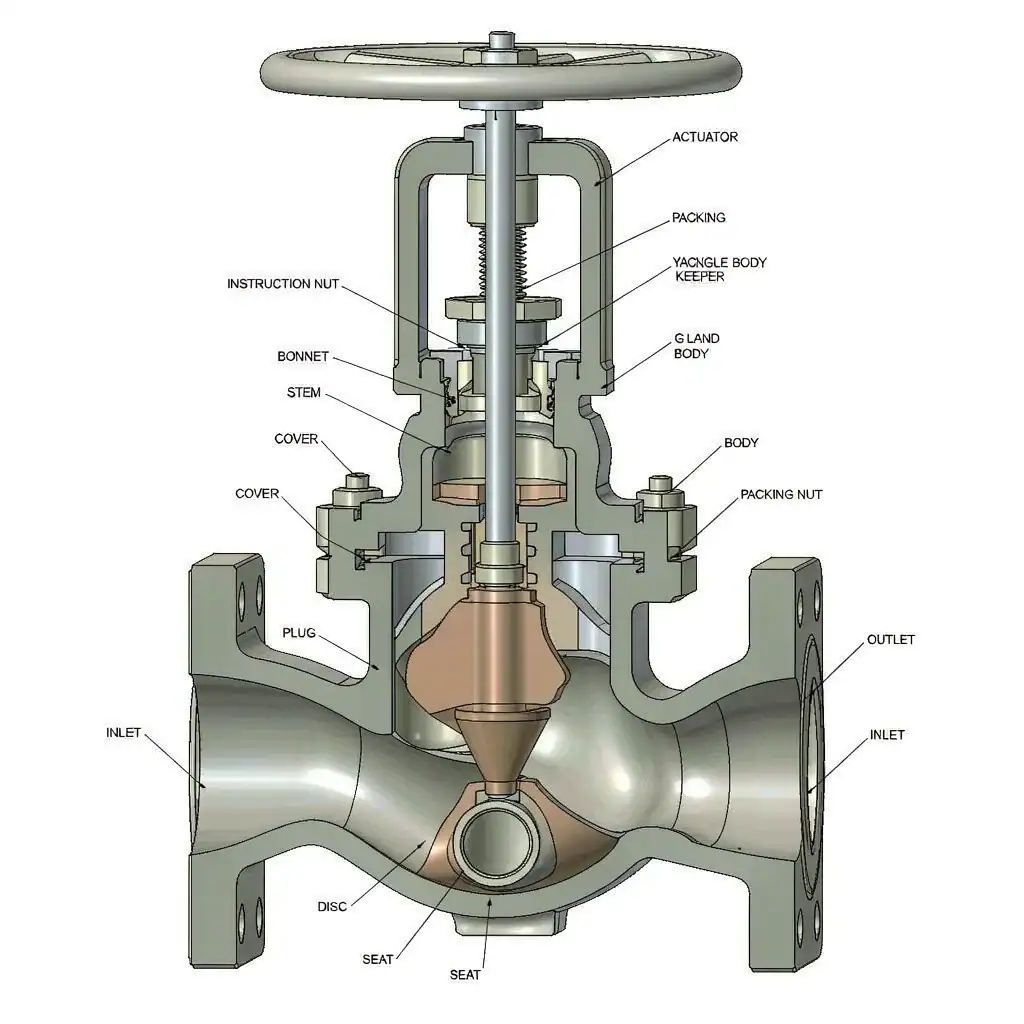
Key Features of Globe Valves:
- Linear motion operation: Stem moves up and down to raise or lower the disc
- Throttling capability: Excellent for flow regulation and control
- Good shutoff: Reliable sealing when closed
- Higher pressure drop: More resistance to flow compared to gate valves
- Unidirectional flow: Must be installed with correct flow direction
Common Globe Valve Types:
- Z-pattern globe valves: Most common, moderate pressure drop
- Y-pattern globe valves: Reduced pressure drop, better for throttling
- Angle globe valves: Flow changes direction 90 degrees
- Piston globe valves: High-pressure applications
- Needle valves: Precise flow control for small sizes
Explore our globe valve products
Gate Valve vs Globe Valve: Key Differences
Understanding the fundamental differences between these two valve types is essential for proper selection.
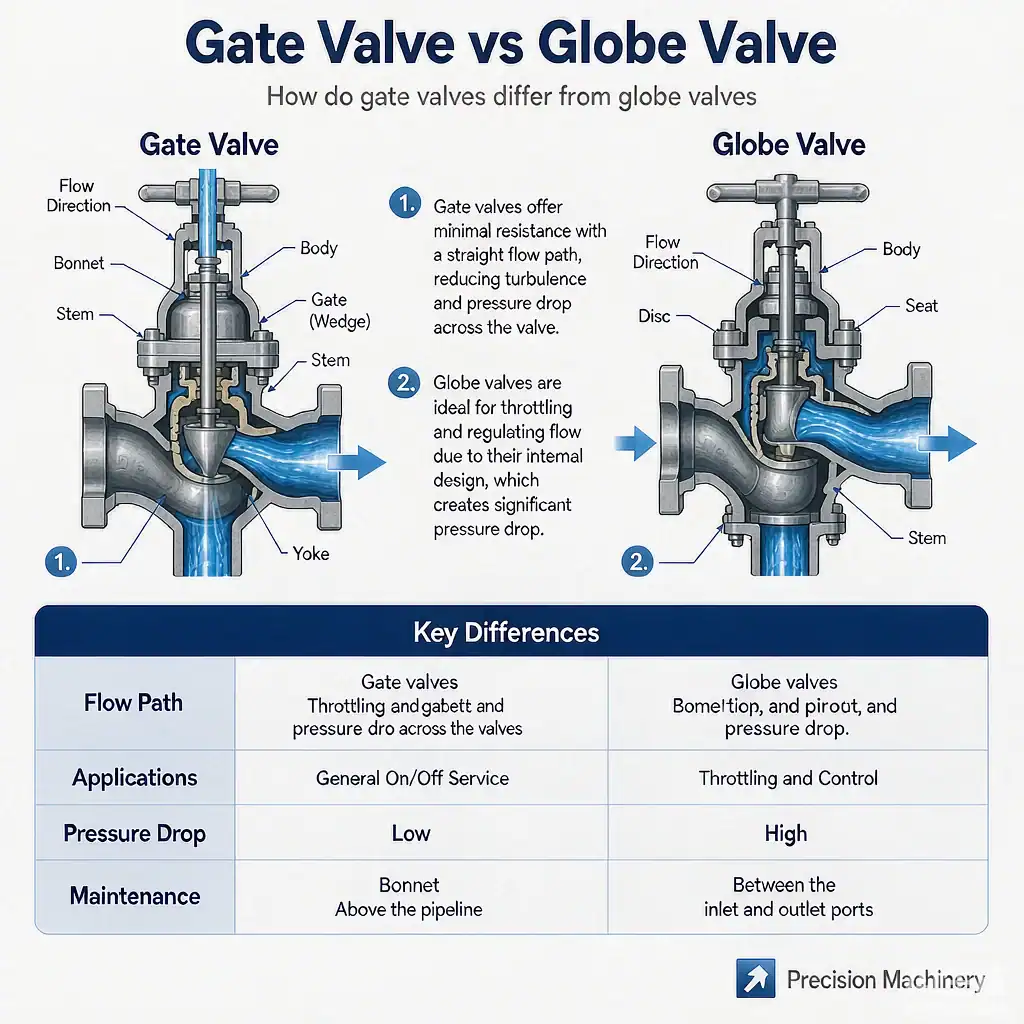
Comparison Table
| Feature | Gate Valve | Globe Valve |
| Primary Function | On/Off isolation | Flow regulation and throttling |
| Flow Characteristic | Full bore, unrestricted | Restricted flow path |
| Pressure Drop | Low when open | Higher due to flow path |
| Throttling Ability | Poor – not recommended | Excellent – designed for it |
| Installation Orientation | Bidirectional | Unidirectional (usually) |
| Stem Motion | Rising stem (usually) | Rising stem |
| Handwheel Operation | Multiple turns | Multiple turns |
| Space Requirement | Longer overall length | Compact design |
| Maintenance Complexity | Simpler | More complex internals |
| Cost | Generally lower | Generally higher |
| Wear Resistance | Good for clean fluids | Better for throttling service |
Detailed Comparison by Application
1. Flow Control Requirements
Gate Valve:
- Best for fully open or fully closed positions
- Not suitable for partial opening (causes vibration and erosion)
- Ideal for isolation applications where flow is either on or off
- Provides minimal resistance when open
Globe Valve:
- Designed for precise flow control and throttling
- Excellent for modulating applications
- Can maintain flow at any position between fully open and closed
- Better for systems requiring frequent flow adjustments
2. Pressure and Temperature Considerations
Gate Valve:
- Suitable for high-pressure applications
- Can handle a wide temperature range
- Lower pressure drop makes it efficient for high-flow systems
- Good for both high and low-pressure differentials
Globe Valve:
- Also suitable for high-pressure service
- Better thermal stability during throttling
- Higher pressure drop can be advantageous for pressure reduction
- Excellent for systems with varying pressure requirements
3. Fluid Type and Cleanliness
Gate Valve:
- Best for clean, non-viscous fluids
- Can handle slurries with proper design
- Prone to fouling in dirty services
- Good for gases, liquids, and steam
Globe Valve:
- Better for various fluid types including viscous media
- Self-cleaning design in some configurations
- Good for fluids with suspended solids
- Excellent for steam and condensation services
4. Maintenance and Operating Costs
Gate Valve:
- Lower initial cost
- Simpler construction means easier maintenance
- Longer service life in on/off service
- Lower operating costs for isolation applications
Globe Valve:
- Higher initial cost due to complex design
- More frequent maintenance for throttling service
- Higher operating costs but justified by performance
- Better total cost of ownership for control applications
When to Choose Gate Valves
Gate valves are the preferred choice when you need:
✅ Complete isolation with minimal pressure drop ✅ Full bore flow for maximum capacity ✅ Infrequent operation (open/close rarely) ✅ Clean service applications ✅ Low-cost solution for on/off control ✅ Bidirectional sealing requirements ✅ High-pressure isolation services ✅ Steam and gas isolation
Typical Gate Valve Applications:
- Water treatment plants: Main line isolation
- Oil and gas pipelines: Pipeline blocking valves
- Power plants: Boiler feedwater isolation
- Chemical processing: Process line isolation
- HVAC systems: Chilled water isolation
- Fire protection systems: Main supply valves
- Marine applications: Ballast and cargo lines
When to Choose Globe Valves
Globe valves are the preferred choice when you need:
✅ Precise flow control and regulation ✅ Throttling service with frequent adjustments ✅ Pressure reduction applications ✅ High-pressure drop requirements ✅ Steam control and modulation ✅ Temperature control systems ✅ Flow measurement installations ✅ Recirculation lines
Typical Globe Valve Applications:
- Power plants: Feedwater control, steam regulation
- Chemical processing: Reactor feed control
- HVAC systems: Chilled water flow control
- Boiler systems: Steam flow modulation
- Oil refineries: Process control loops
- Pharmaceutical industry: Precise dosing applications
- Cooling systems: Flow balance and regulation
Installation and Maintenance Guidelines
Gate Valve Installation
Best Practices:
- Install in vertical or horizontal positions
- Ensure flow direction is correct (though bidirectional)
- Provide adequate space for operation
- Use proper gasket or seal selection
- Follow torque specifications for bolting
Common Mistakes to Avoid:
- ❌ Using for throttling service
- ❌ Partially open position for extended periods
- ❌ Over-tightening during installation
- ❌ Ignoring stem packing maintenance
Globe Valve Installation
Best Practices:
- Install with correct flow direction (arrow on body)
- Ensure access for maintenance
- Provide support for large valves
- Use proper gasket selection for service
- Follow manufacturer’s torque specs
Common Mistakes to Avoid:
- ❌ Installing backward (reverse flow direction)
- ❌ Using for complete isolation when gate valve would suffice
- ❌ Over-torquing stems during maintenance
- ❌ Ignoring seat and disc wear monitoring
Performance Characteristics
Flow Coefficient (Cv) Comparison
The flow coefficient (Cv) indicates the valve’s flow capacity:
Gate Valve Cv:
- Full bore: Cv ≈ pipe size × constant
- Reduced bore: Lower Cv value
- Example: 6″ full bore gate valve Cv ≈ 800-1000
Globe Valve Cv:
- Generally lower than gate valves
- Design-dependent (Z-pattern vs Y-pattern)
- Example: 6″ globe valve Cv ≈ 200-400
Implication: Gate valves provide higher flow capacity for the same pipe size.
Pressure Drop Analysis
Gate Valve:
- Minimal pressure drop when fully open
- ΔP ≈ 0.1-0.5 psi for water at full flow
- Excellent for long pipelines
Globe Valve:
- Higher pressure drop due to flow path
- ΔP ≈ 5-20 psi for water at full flow
- Useful for pressure reduction applications
Cost Analysis
Initial Investment
| Cost Factor | Gate Valve | Globe Valve |
| Unit Price | $ | $$ |
| Installation | $ | $$ |
| Maintenance | $ | $$ |
| Operating Cost | $ | $$ |
Lifecycle Cost
Gate Valve:
- Lower initial cost
- Lower maintenance cost (simple design)
- Lower operating cost (minimal pressure drop)
- Best for isolation applications
Globe Valve:
- Higher initial cost
- Higher maintenance cost (complex internals)
- Higher operating cost (pressure drop)
- Best for control applications
ROI Consideration: Choose based on application requirements, not just initial cost.
Material Selection
Common Materials for Both Valve Types
Carbon Steel:
- ASTM A216 WCB
- Temperature range: -29°C to 425°C
- Cost-effective for general service
- Good mechanical properties
Stainless Steel:
- ASTM A351 CF8 (304 SS)
- ASTM A351 CF8M (316 SS)
- Corrosion resistance
- Hygienic applications
Alloy Steel:
- ASTM A217 WC1 (1.25% Cr)
- ASTM A217 C5 (5% Cr)
- High-temperature service
- Power generation applications
Special Alloys:
- Inconel, Hastelloy, Titanium
- Highly corrosive services
- Extreme temperature applications
- Aerospace and nuclear industries
Industry Standards and Certifications
Applicable Standards
American Standards:
- ASME B16.34: Valves – Flanged, Threaded, and Welding End
- API 600: Gate Valves – Iron, Bronze, and Stainless Steel
- API 602: Compact Cast Iron Gate Valves
- API 623: Integrated Globe and Check Valves
- MSS SP-72: Drop-Closed Brass and Copper Alloy Globe, Gate, and Check Valves
International Standards:
- ISO 17292: Metallic pipes – Dimensions and test pressures for flanges and fittings
- EN 12516-1: Industrial valves – Pressure rating
- BS 5352: Specification for steel wedge gate valves
- BS 5149: Specification for wrought globe and check valves
Certifications
- API Monogram: Quality assurance for petroleum industry
- ISO 9001: Quality management system
- PED 2014/68/EU: Pressure Equipment Directive (Europe)
- NACE MR0175: Sour service requirements
- ASME Stamp: Design and manufacturing compliance
Troubleshooting Guide
Common Gate Valve Problems
| Problem | Cause | Solution |
| Leaking seat | worn seat, debris | Clean or replace seat |
| Hard to operate | packing too tight, corrosion | Adjust packing, lubricate |
| Leaking stem | worn packing | Replace packing |
| Gate stuck | corrosion, debris | Clean and lubricate |
| Vibration when partially open | improper use | Use only fully open/closed |
Common Globe Valve Problems
| Problem | Cause | Solution |
| Leaking seat | worn seat, erosion | Replace seat and disc |
| Poor flow control | worn trim | Replace trim package |
| Hard to operate | binding, corrosion | Inspect and lubricate |
| Cavitation | high pressure drop | Use anti-cavitation trim |
| Vibration | improper sizing | Reevaluate valve size |
FAQ: Gate Valve vs Globe Valve
Q1: Can I use a gate valve for flow control?
A: No, gate valves are not recommended for throttling or flow control. Operating a gate valve in a partially open position causes vibration, erosion of the gate and seat, and premature failure. Always use globe valves for flow control applications.
Q2: Which valve has a lower pressure drop?
A: Gate valves have significantly lower pressure drop when fully open due to their full bore design. Globe valves have a more tortuous flow path, resulting in higher pressure drop. For long pipelines where pressure loss is critical, gate valves are preferred.
Q3: Are globe valves only for liquid service?
A: No, globe valves are excellent for both liquid and gas services. They are particularly popular in steam systems due to their excellent throttling capability and ability to handle thermal cycling. Many power plants use globe valves extensively for steam control.
Q4: Can I install a globe valve in any orientation?
A: Globe valves should be installed with the flow direction matching the arrow on the valve body. Most globe valves are designed for unidirectional flow. Installing them backward can cause poor sealing and potential damage.
Q5: Which valve is better for wastewater applications?
A: Gate valves are generally better for wastewater applications due to their straight-through flow path that minimizes clogging. Globe valves can be used but may require special designs (like knife gate valves) for dirty services with solids.
Conclusion
Both gate valves and globe valves are essential components in industrial piping systems, but they serve different purposes. Gate valves excel at providing reliable isolation with minimal pressure drop, making them ideal for on/off service. Globe valves provide superior flow control and throttling capability, making them perfect for regulation applications.
The key to successful valve selection is understanding your specific application requirements. Consider factors such as:
- Flow control needs
- Pressure and temperature conditions
- Fluid type and cleanliness
- Operating frequency
- Maintenance requirements
- Budget constraints
At Oucang Valve, we manufacture high-quality gate valves and globe valves to international standards. Our products are available in various materials, sizes, and pressure classes to meet your specific requirements.
Ready to Get the Right Valves for Your Project?
Oucang Valve specializes in manufacturing industrial valves and flanges with over 20 years of experience. Whether you need gate valves, globe valves, or other piping solutions, we can provide products that meet your exact specifications.
Contact us today for:
- Free technical consultation
- Competitive factory pricing
- Fast delivery times
- Custom OEM solutions
- Full material certifications
References and Further Reading
- ASME B16.34: Valves – Flanged, Threaded, and Welding End
- API 600: Gate Valves – Iron, Bronze, and Stainless Steel
- API 623: Integrated Globe and Check Valves
- ISO 17292: Metallic pipes – Dimensions and test pressures
- EN 12516-1: Industrial valves – Pressure rating
- MSS SP-72: Drop-Closed Brass and Copper Alloy Valves