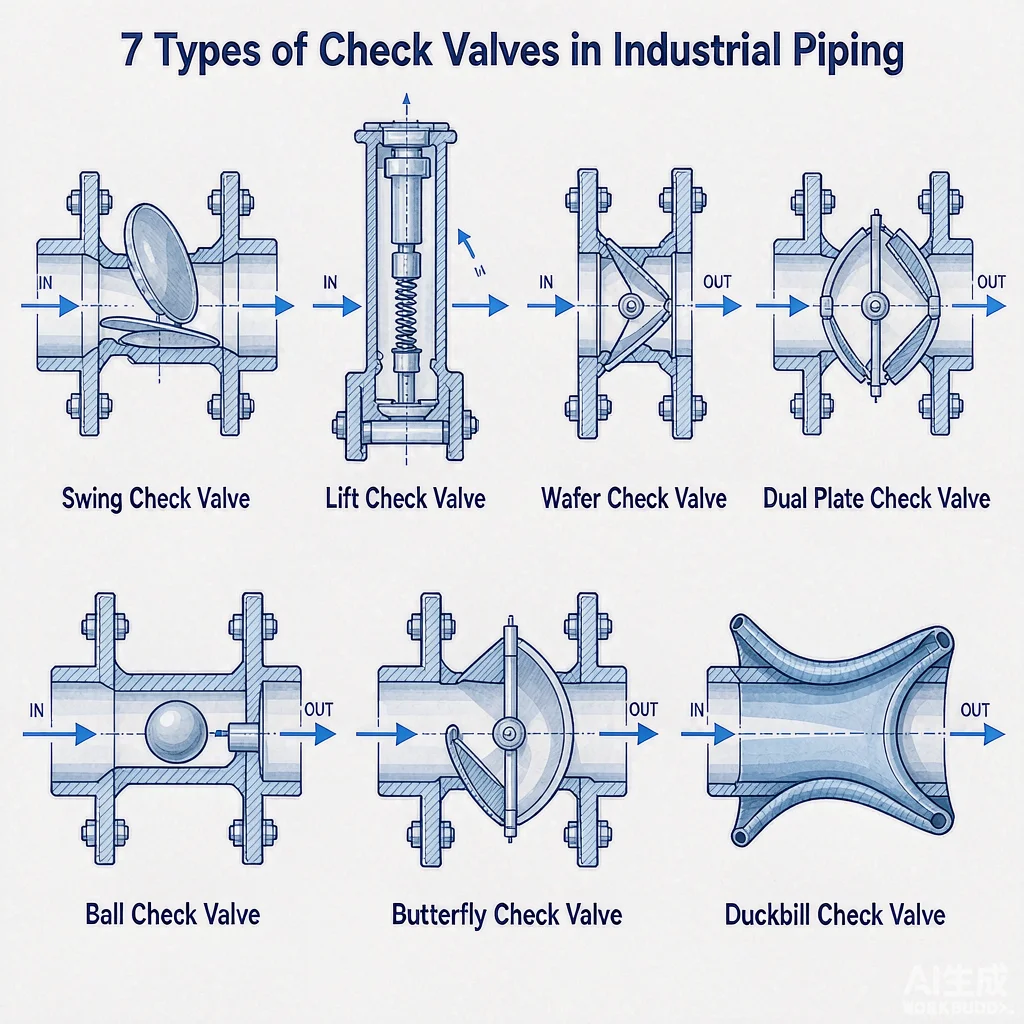
In industrial piping systems, check valves (also known as non-return valves or one-way valves) are essential components that prevent backflow and protect equipment from damage. Understanding the different check valve types is crucial for selecting the right valve for your specific application.
As a professional valve manufacturer with over 20 years of experience, Oucang Valve has worked with thousands of clients across various industries. In this comprehensive guide, we’ll explore all major check valve types, their working principles, advantages, limitations, and ideal applications.
What is a Check Valve?
A check valve is a mechanical device that allows fluid (liquid, gas, or slurry) to flow in only one direction while preventing reverse flow. Unlike other valve types that require manual or actuator operation, check valves operate automatically based on flow conditions.
Primary Functions:
- Prevent backflow: Stop media from flowing backward when pump stops or pressure drops
- Protect equipment: Safeguard pumps, compressors, and other sensitive equipment
- Maintain system integrity: Ensure proper flow direction in complex piping networks
- Prevent contamination: Keep clean and dirty media separated in dual-line systems
- Water hammer prevention: Reduce pressure surges caused by sudden flow reversal
Working Principle:
Check valves operate on a simple principle: flow-induced opening and pressure-induced closing. When forward flow pressure exceeds the valve’s cracking pressure, the disc or closure mechanism opens. When flow stops or reverses, spring force, gravity, or back pressure closes the valve.
Types of Check Valves
There are several types of check valves, each designed for specific applications and operating conditions. Let’s explore each type in detail.
1. Swing Check Valve
The swing check valve is the most commonly used check valve type in industrial applications. It features a hinged disc that swings open on a trunnion when flow passes through and closes by gravity and reverse flow pressure.
Construction:
- Hinged disc mounted on a trunnion
- Full-bore design (minimal pressure drop)
- Horizontal or vertical installation (with spring assist for vertical)
- Available in wafer, lug, or flanged end connections
Advantages:
✓ Low pressure drop ✓ Simple construction ✓ Affordable price ✓ Wide size range (2″ to 48″) ✓ Suitable for high-pressure applications
Limitations:
✗ Slow closing speed (can cause water hammer) ✗ Requires maintenance space ✗ Not suitable for pulsating flow ✗ Can stick in open position if debris accumulates
Best Applications:
- Water supply systems
- Oil and gas pipelines
- Steam lines
- Hydraulic systems
- Cooling water systems
Typical Pressure Range:
- Class 125: Up to 230 psi (16 bar)
- Class 150: Up to 285 psi (19.6 bar)
- Class 300: Up to 740 psi (51 bar)
2. Lift Check Valve
The lift check valve uses a vertically moving disc or piston that lifts off the seat when forward flow occurs and drops back onto the seat when flow stops or reverses. This design provides faster closing than swing check valves.
Construction:
- Guided disc or piston
- Vertical flow path
- Spring-assisted or gravity-operated closing
- Usually installed in horizontal pipes only
Advantages:
✓ Faster closing action ✓ Better for high-pressure applications ✓ Compact design ✓ Less susceptible to water hammer ✓ Precise sealing
Limitations:
✗ Higher pressure drop than swing check ✗ Limited to horizontal installation ✗ More expensive than swing check ✗ Smaller size range available
Best Applications:
- High-pressure steam systems
- Boiler feedwater lines
- Compressor discharge
- High-velocity pipelines
- Critical service applications
Typical Pressure Range:
- Class 150: Up to 285 psi (19.6 bar)
- Class 300: Up to 740 psi (51 bar)
- Class 600: Up to 1,480 psi (102 bar)
3. Wafer Check Valve
The wafer check valve is a lightweight, compact design that fits between two pipe flanges and is secured by the pipeline bolts. It’s one of the most popular check valve types due to its cost-effectiveness and easy installation.
Construction:
- Disc-type closure (swing or dual plate)
- Wafer body design
- No threads or flanges on valve itself
- Lightweight and compact
Advantages:
✓ Cost-effective solution ✓ Easy to install and maintain ✓ Lightweight design ✓ Space-saving ✓ Good for low-pressure applications
Limitations:
✗ Not suitable for high-pressure service ✗ Cannot be used as isolation valve ✗ Limited size range ✗ May leak if flange faces are damaged
Best Applications:
- Low-pressure water systems
- HVAC systems
- Compressed air lines
- General industrial service
- Budget-conscious projects
Typical Pressure Range:
- PN10: Up to 145 psi (10 bar)
- PN16: Up to 232 psi (16 bar)
- Class 150: Up to 285 psi (19.6 bar)
4. Dual Plate (Double Disc) Check Valve
The dual plate check valve features two spring-loaded半圆形discs that open and close together. This design combines the benefits of swing and lift check valves while offering faster closure and lower pressure drop.
Construction:
- Two semi-circular discs hinged at center
- Spring-assisted closing
- Wafer body design
- Zero-leakage when closed
Advantages:
✓ Very fast closing action ✓ Lower pressure drop ✓ Compact and lightweight ✓ Suitable for vertical installation ✓ Reduced water hammer potential
Limitations:
✗ More complex mechanism ✗ Higher cost than simple swing check ✗ Limited to smaller sizes ✗ Springs may fatigue over time
Best Applications:
- Pump protection
- Compressor discharge
- Steam systems
- High-cycle applications
- Systems sensitive to water hammer
5. Ball Check Valve
The ball check valve uses a spherical ball that lifts off the seat when forward flow occurs and seats under gravity or spring pressure when flow reverses. This simple design is effective for small diameter applications.
Construction:
- Spherical ball as closure member
- Vertically oriented flow path
- Spring or gravity assisted
- Typically wafer or threaded connections
Advantages:
✓ Simple construction ✓ Quick response ✓ Good for small sizes ✓ Reliable sealing ✓ Affordable price
Limitations:
✗ Limited to small diameters (up to 4″) ✗ Not suitable for high flow rates ✗ Ball can bounce in pulsating flow ✗ Limited pressure ratings
Best Applications:
- Small diameter pipelines
- Instrument air systems
- Sample lines
- Low-flow applications
- Laboratory equipment
6. Butterfly Check Valve
The butterfly check valve uses a disc mounted on a rotating shaft that swings open with forward flow and closes against the flow path when reverse flow occurs. This design is similar to butterfly valves but operates automatically.
Construction:
- Disc mounted on central shaft
- Wafer or lug body
- Spring-assisted or gravity closing
- Compact design
Advantages:
✓ Compact and lightweight ✓ Low pressure drop ✓ Fast closing action ✓ Suitable for large diameters ✓ Cost-effective for large sizes
Limitations:
✗ Limited pressure ratings ✗ Not suitable for high-velocity applications ✗ Disc may flutter in low flow ✗ Requires adequate space for operation
Best Applications:
- Large diameter water pipelines
- Cooling water systems
- Sewage treatment
- Low-pressure industrial service
- Space-constrained installations
7. Duckbill Check Valve
The duckbill check valve is a specialized type made from elastomeric materials (rubber or thermoplastic) that forms a duckbill-shaped opening. It opens with forward flow and closes when flow stops or reverses.
Construction:
- Elastomeric material body
- Duckbill-shaped opening
- No moving parts
- Flexible design
Advantages:
✓ No moving parts (maintenance-free) ✓ Corrosion resistant ✓ Silent operation ✓ Suitable for corrosive media ✓ Low cost
Limitations:
✗ Limited to low pressure ✗ Temperature restrictions ✗ Not suitable for all chemicals ✗ May degrade over time
Best Applications:
- Outfall discharges
- Marine applications
- Corrosive chemical lines
- Saltwater systems
- Wastewater treatment
Check Valve Selection Guide
Choosing the right check valve type requires considering multiple factors including flow characteristics, pressure requirements, media properties, and operating conditions.
Selection Checklist
1. Flow Characteristics
- Steady flow or pulsating flow?
- High velocity or low velocity?
- Clean media or含有 solids?
- Single phase or multi-phase?
2. Pressure Requirements
- Operating pressure range
- Maximum allowable pressure drop
- Cracking pressure requirements
- Water hammer potential
3. Media Compatibility
- Chemical composition
- Temperature range
- Viscosity
- Abrasiveness
- Cleanliness
4. Installation Constraints
- Available space
- Orientation (horizontal/vertical)
- Access for maintenance
- Pipeline configuration
5. Operational Requirements
- Frequency of cycling
- Required sealing performance
- Noise limitations
- Safety criticality
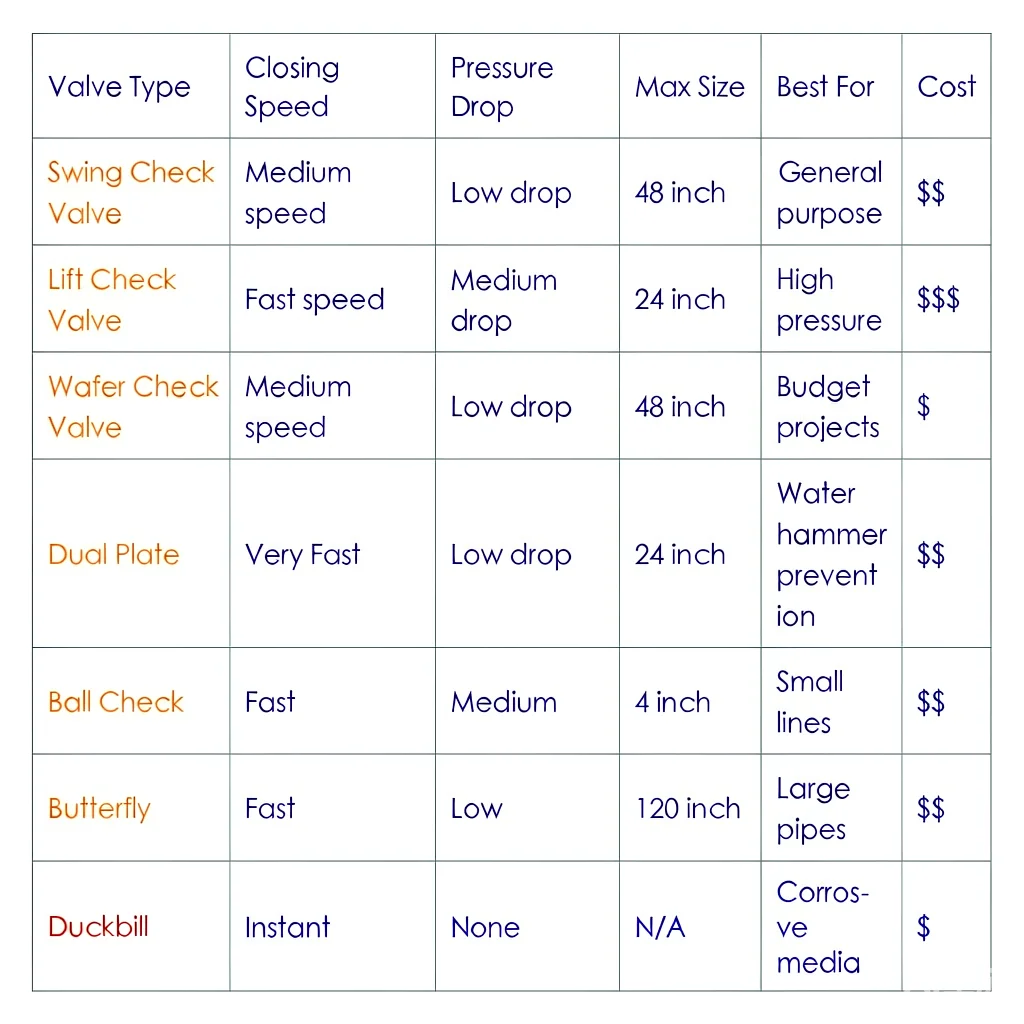
Comparison Table: Check Valve Types
| Check Valve Type | Closing Speed | Pressure Drop | Max Size | Best For | Cost |
| Swing Check | Slow | Low | 48″ | General purpose, high pressure | $$ |
| Lift Check | Fast | Medium | 24″ | High pressure, steam | $$$ |
| Wafer Check | Medium | Low | 48″ | Low pressure, budget projects | $ |
| Dual Plate | Very Fast | Low | 24″ | Water hammer sensitive systems | $$ |
| Ball Check | Fast | Medium | 4″ | Small diameter, instrument air | $$ |
| Butterfly Check | Fast | Low | 120″ | Large diameter water systems | $$ |
| Duckbill | Instant | None | N/A | Corrosive media, outfalls | $ |
Common Applications by Check Valve Type
Water Treatment Industry
- Primary choice: Swing check valves (Class 150/300)
- Alternative: Wafer check valves for low-pressure sections
- Special cases: Duckbill valves for outfall discharge
Oil and Gas Industry
- Primary choice: Lift check valves for high-pressure lines
- Alternative: Dual plate check valves for compressor protection
- Pipeline: Swing check valves in transmission lines
Power Generation
- Primary choice: Lift check valves for boiler feedwater
- Condensate: Dual plate check valves
- Cooling water: Swing or butterfly check valves
Chemical Processing
- Primary choice: Material-specific selection (SS316, Hastelloy, PTFE-lined)
- Corrosive media: Duckbill check valves
- High purity: Weld-end check valves
HVAC Systems
- Primary choice: Wafer check valves
- Chilled water: Swing check valves
- Boiler systems: Lift check valves
Installation Best Practices
Pre-Installation Checks
- Verify correct valve type for application
- Check flow direction arrow matches pipeline flow
- Inspect valve for shipping damage
- Clean pipe ends and flange faces
- Use proper gaskets
Installation Guidelines
- Orientation: Install according to manufacturer’s recommendations
- Space: Allow adequate space for maintenance
- Support: Support heavy valves to prevent pipe stress
- Tightening: Use cross-tightening pattern for bolts
- Testing: Test valve operation after installation
Common Installation Mistakes
| Mistake | Consequence | Prevention |
| Wrong flow direction | Valve won’t open properly | Check arrow orientation |
| Improper support | Pipe stress and failure | Use proper supports |
| Over-tightening bolts | Damaged gaskets/seats | Follow torque specifications |
| No isolation valve | Cannot维修 | Install upstream isolation |
| Missing strainer | Debris damage | Install Y-strainer upstream |
Frequently Asked Questions (FAQ)
Q1: What is the difference between a swing check valve and a lift check valve?
Swing check valves use a hinged disc that swings open and are suitable for horizontal and vertical installation. Lift check valves use a vertically moving disc and must be installed horizontally. Lift check valves close faster and are better for high-pressure applications, while swing check valves have lower pressure drop and are more versatile.
Q2: Which check valve type is best for preventing water hammer?
Dual plate check valves and lift check valves are best for preventing water hammer due to their fast closing action. Swing check valves are slower and can contribute to water hammer if not properly sized. For critical applications, consider installing surge arrestors or slow-close check valves.
Q3: Can check valves be used in vertical pipelines?
Yes, but you need to select the right type. Swing check valves can work in vertical upflow applications with spring assist. Lift check valves are not suitable for vertical installation. Dual plate check valves can work in both horizontal and vertical orientations. Always consult the manufacturer’s guidelines.
Q4: How do I size a check valve?
Check valve sizing depends on:
- Flow rate: Calculate maximum and minimum flow
- Pressure drop: Ensure acceptable pressure loss
- Pipe size: Match to pipeline diameter
- Cracking pressure: Select appropriate opening pressure
- Velocity: Keep within recommended limits (typically 2-10 fps)
Q5: What maintenance do check valves require?
Regular maintenance includes:
- Visual inspection for leaks
- Check operation during normal flow
- Clean strainers upstream
- Lubricate moving parts (if applicable)
- Test closure mechanism annually
- Replace worn seals and gaskets
Q6: How long do check valves last?
Typical lifespan:
- Swing check valves: 10-20 years
- Lift check valves: 15-25 years
- Dual plate check valves: 10-15 years
- Duckbill check valves: 5-10 years (depends on media)
Lifespan depends on operating conditions, media compatibility, and maintenance frequency.
Why Choose Oucang Valve for Check Valves?
As a professional valve manufacturer with over 20 years of experience, Oucang Valve offers:
✓ Complete product range: All check valve types in stock ✓ Quality assurance: ISO 9001, API, CE certified ✓ Custom solutions: Special materials and sizes available ✓ Competitive pricing: Direct factory pricing ✓ Fast delivery: Standard items in stock ✓ Technical support: Expert assistance throughout selection
Conclusion
Selecting the right check valve type is critical for system reliability, safety, and cost-effectiveness. Each type has unique advantages and limitations that make it suitable for specific applications.
Key takeaways:
- Swing check valves: Best for general purpose, high-pressure applications
- Lift check valves: Ideal for high-pressure, fast-closing requirements
- Wafer check valves: Cost-effective for low-pressure systems
- Dual plate check valves: Excellent for water hammer prevention
- Butterfly check valves: Suitable for large diameter applications
- Duckbill check valves: Perfect for corrosive media and outfalls
Consider your specific requirements for pressure, flow, media, and installation constraints when making your selection.
Get Your Free Quote Today
Need help selecting the right check valve for your project? Our technical team is ready to assist you.
Contact Oucang Valve:
- 📧 Email: manager-minly@oucangflange.com
- 🌐 Website: https://oucangflange.com
- 📱 WhatsApp: +86 15067828716
Request a free quote today!